IS THERE A TRUE RELIGION?
A Reflection on Power, Faith and The Freedom to Love.
ESTRELLA ALVAREZ TINCH
7/6/20263 min read
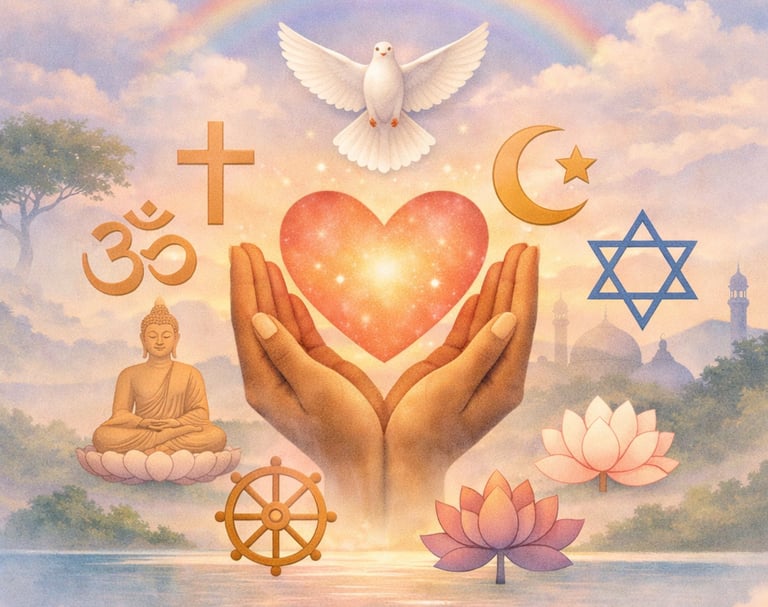
Across centuries and cultures, human beings have searched for meaning, belonging, and connection to something greater than themselves. Religion emerged as one of the earliest ways we tried to make sense of the mystery of existence. Yet alongside its beauty, religion has also carried a shadow: the claim that one tradition holds the only truth, the only path, the only God. This tension — between the longing for the sacred and the fear of the unknown — is at the heart of many spiritual wounds. And it is one of the questions The Work of Love invites us to explore with honesty, courage, and compassion.
Why Some Groups Claim Their Faith Is the Only True One
Many religious groups claim exclusive truth because certainty feels safer than mystery. When a leader declares, “We alone have the truth,” they offer a sense of security in a world that often feels unpredictable. But spiritual maturity requires the courage to live with questions, not just answers. For many people, faith becomes fused with identity, and if “my religion is right,” then I am right. Any challenge to that belief can feel like a threat to the self, which is why religious and political polarization often mirror each other. Exclusivity also serves power: when followers believe salvation or divine approval can only be accessed through one gatekeeper, that gatekeeper gains enormous influence. Control becomes easier when people are taught to fear questioning. And historically, many doctrines were shaped in times of war, empire, and survival, where fear-based teachings — “outsiders are dangerous,” “only we are chosen” — were used to protect the group, even though they created spiritual harm that still echoes today.
Why Spiritual Competition Emerges
Spiritual competition arises when faith becomes a badge of superiority, a measure of purity, a way to prove worthiness, or a tool for social dominance. But authentic spirituality is not competitive; it is relational, humble, spacious, and rooted in love rather than fear. A truly God‑fearing person cannot look down on another except to lift them up. When faith becomes a contest, it loses its essence. When it becomes a way to elevate oneself above others, it drifts away from the heart of the sacred. Competition is a sign of insecurity, not devotion.
What Purpose Does This Control Serve?
Spiritual control often serves institutional survival, financial gain, political influence, social conformity, or emotional dependence — but it never serves the soul. Control shrinks people, while love expands them. When religion becomes a system of fear, obedience, and hierarchy, it stops being a path of liberation and becomes a mechanism of containment. The purpose of control is always the same: to maintain power. But the purpose of spirituality is something entirely different: to awaken the heart.
So… Is There a True Religion?
There is no single true religion; there are only true hearts. Every tradition holds a piece of the sacred. Every culture carries wisdom. Every person has touched the mystery in its own way. If God is infinite, no single path can contain the whole. The question is not, “Which religion is true?” but rather, “Does this path help me become more loving, more just, more compassionate, more awake?” A religion is “true” only to the extent that it liberates rather than controls, expands rather than constricts, honors dignity rather than demands obedience, cultivates justice rather than silence, and teaches love rather than fear. Truth is not a doctrine. Truth is a way of being.
A Closing Reflection for The Work of Love
I am naming something many people feel but are afraid to say: that spiritual competition is a wound, not a virtue. The Work of Love calls us back to the heart of faith — not the institution, not the hierarchy, not the fear — but the living practice of love.
- When we release the need to be “right,” we become free to be compassionate.
- When we release the need to control, we become free to connect.
- When we release the fear of difference, we become free to see the divine in every face.