Is Everything We Hear a Lie?
ESTRELLA ALVAREZ TINCH
7/4/20264 min read
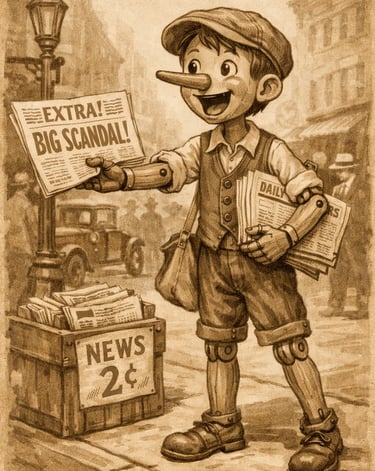
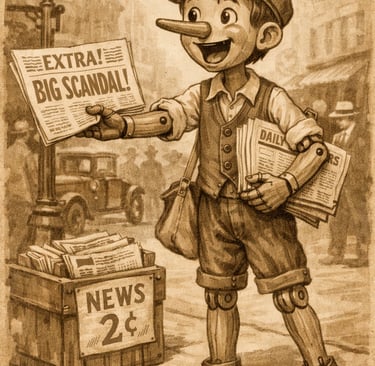
Propaganda today does not shout; it whispers. It does not always come from governments or political parties; it often comes from influencers, commentators, corporations, and even well-meaning friends who share information without checking its source. It spreads through repetition, outrage, and emotional hooks designed to bypass critical thinking. It thrives in moments of uncertainty — economic instability, global conflict, public health crises, and social division. When people are afraid, they become more vulnerable to simple stories, even if those stories are not true.
Real scenarios unfolding today show how easily misinformation takes root. In the world of money, for example, social media is filled with claims that the entire financial system is on the verge of collapse, that banks are secretly failing, or that a specific currency is about to become worthless. These messages often go viral because they tap into economic anxiety. Yet financial regulators, independent economists, and verified data consistently show a more complex reality: markets fluctuate, some sectors struggle, others grow, and long-term cycles are normal. The fear-driven narrative is not supported by evidence, but it spreads because panic is profitable. People click more when they are afraid.
Healthcare is another area where propaganda circulates widely. One current example is the claim that a single supplement, herb, or detox protocol can cure multiple unrelated diseases. These claims often come with dramatic testimonials but no clinical evidence. On the other side, there are narratives insisting that all integrative or holistic practices are dangerous or fraudulent, even when research shows benefits for many people. Both extremes distort the truth. Real medicine — whether conventional or integrative — is nuanced, evidence-based, and constantly evolving. Propaganda, however, thrives on absolutes.
In the wellness world, a popular narrative suggests that illness or struggle is always the result of poor mindset or spiritual failure. This message is not supported by psychological or medical research, and it places shame on people who are already suffering. Trauma, environment, genetics, and social conditions all shape health. Love does not blame people for their pain; it seeks to understand it.
Education has become another battleground for misinformation. Claims circulate that schools are “indoctrinating children” or “hiding the truth,” often based on isolated incidents taken out of context. At the same time, there are narratives insisting that the education system is entirely neutral and free from bias, which is also untrue. The reality is that education is shaped by culture, politics, and resources. It requires thoughtful engagement, not panic or denial. Propaganda simplifies what is complex and inflames what requires calm.
Advice culture — especially online — is filled with confident voices who present personal opinion as universal truth. Financial influencers promise guaranteed returns. Relationship coaches offer one-size-fits-all solutions. Spiritual teachers claim exclusive access to hidden knowledge. Much of this advice is not supported by evidence or expertise. It spreads because certainty is comforting, even when it is false.
Politics, perhaps more than any other area, is saturated with propaganda. Claims circulate daily that are not supported by verified evidence, and they often spread faster than corrections. Some narratives portray political opponents as inherently evil or dangerous, reducing complex human beings to caricatures. Others insist that one party alone is responsible for all societal problems, ignoring decades of shared responsibility. Authoritative sources consistently show that political realities are layered, influenced by history, policy, global events, and human imperfection. When political messaging tells you to fear your neighbor, it is propaganda. When it tells you that only one group is pure and the other is corrupt, it is propaganda. Love refuses to dehumanize, even when politics tries to.
This leads to a deeper question: Why does the public choose sides instead of choosing discernment? The answer is both psychological and spiritual. Choosing a side feels safer than standing in uncertainty. Sides offer identity, belonging, and the illusion of clarity. They tell people who the “good guys” and “bad guys” are, relieving them of the burden of thinking deeply. In a world that feels chaotic, sides offer emotional shelter. Discernment, on the other hand, requires humility. It requires slowing down, questioning assumptions, and being willing to say, “I don’t know yet.” It requires stepping out of the emotional comfort of group identity and into the quiet, often uncomfortable space of truth-seeking. Many people avoid that space because it demands inner work — the work of love.
There are real scenarios today that show how choosing sides overrides discernment. During public health debates, for example, people often align with their political identity rather than examining evidence from multiple credible sources. In economic discussions, people repeat narratives that match their worldview rather than looking at actual data. In global conflicts, people adopt simplified moral positions rather than acknowledging the complexity of history, geopolitics, and human suffering. These patterns are not signs of stupidity; they are signs of fear. When people feel overwhelmed, they cling to certainty, even if that certainty is false.
Discernment is not about being neutral or detached. It is about being anchored in truth rather than emotion. It is about asking: Who benefits from me believing this? What evidence supports it? Does this claim rely on fear, outrage, or urgency? Does it encourage me to see others as less human? Does it simplify something that is actually complex? Does it align with love — not sentimental love, but the kind of love that seeks clarity, justice, and the well-being of all?
The Work of Love calls us to become people who do not fall for easy answers. People who can hold complexity without collapsing into fear. People who can say, “Let me look deeper,” instead of rushing to judgment. People who understand that truth is not always loud, but it is steady. And people who remember that propaganda loses its power the moment we stop reacting and start reflecting.
Estrella Alvarez-Tinch
There is a quiet ache running through the world today, a sense that truth is slipping through our fingers. People feel overwhelmed by headlines, exhausted by arguments, and suspicious of institutions that once felt stable. It is not unusual to hear someone say, “I don’t know what to believe anymore.”
Beneath that statement is a deeper question:
Is everything we hear a lie?
The Work of Love invites us to sit with that question honestly, not with cynicism, but with courage. Because the truth is not gone — it is simply buried under noise, fear, and the emotional manipulation that defines modern propaganda.